
An Interview with Robert E. Wallace

Robert E. Wallace
For 20 years, Rev. Dr. Robert Wallace worked as a professor of biblical studies, striving to bridge the gap between the academy and the church. With research interests in the Psalms and pedagogy, most of his academic career focused on helping freshman students better understand the transformational story of the Bible.
In 2018 he was called to be senior pastor at Mclean Baptist Church in Mclean, Virginia. For the past six years, he has worked to bridge that same gap from the side of the church rather than the academy. He stays active in the classroom, leading workshops and guest lecturing within the Institute for Justice Formation and teaching as an adjunct professor.
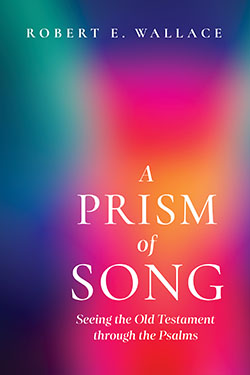
What were you hoping to achieve with your new book, A Prism of Song: Seeing the Old Testament through the Psalms?
The book was originally envisioned to be a text for an “Introduction to Old Testament” class. But I think even before I answered the full-time call to pastor a church, the focus of the book began to broaden. I believe anyone who would want to know how to better read the Old Testament would find value in the book. It brings together three of my passions: my love of the psalms, pedagogy, and trying to make the Old Testament understandable.
I believe that God is Jesus and Jesus is God, and I believe that this has always been the case. But I also recognize there are times it is hard to see that in the Bible. When that happens, someone’s culture is getting in the way. It could be the ancient culture or the contemporary culture (it’s likely both!). My hope is that this book helps readers of the Old Testament peel back some of those cultural obstacles and better see the God they know revealed in Christ throughout the Bible.
What is it about the Psalms that make it unique and useful in understanding the rest of the Old Testament?
The psalms are unique in the Bible. While we confess that the majority of the Bible are words from God. The Psalms originated as words to God, which through the canonical process became words from God. In other words, these were the words sung and prayed to God, that God felt needed including!
While the psalms make their own unique contribution to the story of scripture, they also contain a sample of the major themes of the Old Testament. Creation, Torah, Settlement, Kingship, Wisdom, etc. The book of Psalms provides the earliest recorded interaction that Israel had with these traditions. As a result, it becomes a useful dialogue partner as we see what was included, how it was included, and what wasn’t included.
My former professor, Bill Bellinger, liked to say that there was a reason the Bibles we all received as children were a “New Testament and the Psalms.” If you had the book of Psalms, you had a pretty good sample of the Old Testament.
Can you talk a little about the structure of your book? Why did you put it together the way you did and how did you decide what quotations to use?
The book follows a (very roughly) canonical and topical approach. One exception to that is that I open with a brief survey of Psalms to help the reader better understand what follows. I also discuss translation philosophy broadly, and my translation philosophy specifically (since I translated the over 1000 verses I used in the text).
The verses basically selected themselves. When I wanted to talk about creation, it was obvious to go to Psalm 8, Psalm 74, and Psalm 104 alongside Genesis 1 and 2. When I talk about Torah, Psalms 1, 19, and 119 were natural selections. Occasionally a topic permeates the psalms so thoroughly that I had to be more selective. On a topic like kingship, it was important to focus on the most important texts, like Psalms 72 and 101 for human kingship and Psalms 93-100 for divine kingship.
What are some misconceptions or challenges surrounding studying and reading the Old Testament?
The misconception I see the most is a sort of latent Marcionism in the church. Marcion was an early church heretic who saw such a dramatic difference in the character of God in the Old Testament when compared to the New Testament, he assumed the only explanation was the Old Testament God was a different god completely! If we take seriously the incarnation, then the God of the Old Testament must be the God we see revealed in the Jesus of the gospels. I often say to people reading the Bible, “If the God of your reading doesn’t look like the Jesus of the gospels, you took a wrong turn somewhere. Something is getting in the way.”
What advice can you offer to those wanting to contextually connect with the Old Testament, especially younger generations?
Remember that God is always meeting people where they are. The miracle of Pentecost, the incarnation, even the Tabernacle in Exodus, is an example of a god who goes where the people are. God speaks the people’s language and into their culture.
This is a wonderful statement of God’s grace, but we must be wary that we don’t interpret that to mean that God necessarily wants the people to be where God meets them! We must remember to “translate the culture” of the ancient world to better hear what God is saying. For example, I do not believe that God advocates patriarchy, misogyny, or violence, but I absolutely recognize that a patriarchal, misogynistic, and violent culture is the backdrop of the biblical text. Jesus provides the template for us to know how to read scripture better and filter through the culture to see what God desires for humanity.
The Bible itself is an incarnational mystery: simultaneously the word of God and the word of human beings. If I better understand the context of the human beings, I can better hear what God is saying to me!
What is about the book of Psalms that holds such a special and lasting place in our culture, even outside of the church?
If I had to pick one characteristic, it would be authenticity. As I said, the psalms first represented words to God, and those words are often uncompromisingly honest. For example, over half the psalms have lament characteristics. Over half of the psalms in ancient Israel’s hymnbook are complaining about illness, enemies, injustice, and numerous other (very human) problems. There is even a song about desiring a violent vengeance on a hated enemy. The last word of Psalm 88 in Hebrew and some English translations is “darkness.” This worship song literally ends in darkness and an uncertain future.
The book of Psalms is a real book about real people with real questions. There is no attempt to spiritually bypass problems or “fix” challenging theology. I believe culture respects authenticity, and the Psalm contain that in abundance!
How does your writing impact your faith? What part of this book excited you most?
I think writing helps me work out my faith. In teaching it was often a student’s question, asked in just the right way, that ignited some of the most elegant expressions of my faith. I have heard that some people map out their entire books, chapter by chapter, and entire chapters, section by section, before they start writing. That was not my process! I often jumped in with my methodology (i.e., the psalms can help us read the rest of the Old Testament) and began writing to see where that would take me.
Anne Lamott has a famous quote about “first drafts” that I won’t repeat here, but she has my complete agreement. Often, it was like putting together a puzzle when you don’t know what the picture is. At times, I would read a chapter and think, “This is clunky, and it makes no sense!” I would move one paragraph, maybe make the middle the introduction, remove the parts that don’t belong, an suddenly the picture came into focus!
That was the most rewarding and exciting part of writing—when the book revealed a picture that I didn’t realize I had until the words started flowing.
What nurtures your imagination?
To nurture my imagination, I have found great benefit in conversations with and presentations by individuals whose life experience is different from mine. At national meetings, I like to attend the sections on biblical interpretation from a variety of cultures. The readings and interpretations that come from African, Polynesian, Latino, or Asian biblical scholars help me to see the blind spots in my own readings. They help me to see that ideas I took as self-evident sometimes reflect my own ideological background and bias being read into the text!
We read texts in community, and the more diverse community we read with, the richer our readings.
Login and Registration Form