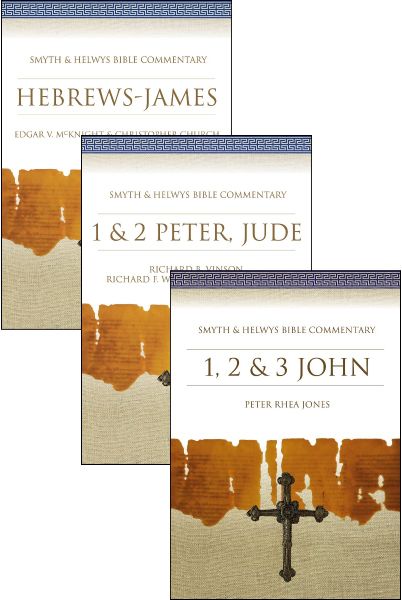
Edgar V. McKnight; Christopher Church; Richard B. Vinson, Richard F. Wilson, Watson E. Mills; Peter Rhea Jones
Hebrews (Edgar McKnight): By bringing the ancient text into the world of present readers and to take readers back to the world of Hebrews, we are able to frame the author's treatment of the problems of our spiritual ancestors from the perspective of our modern world and problems presented in our pilgrimage.
James (Christopher Church): One helpful way to think about the Letter of James is to view it as one might an important archaeological discovery or artifact: it is a surviving representative of a once-flourishing Jewish Christianity. The Letter of James reveals a form of ancient Christianity that is distinctly different from the Pauline line that later predominated.
1 Peter (Richard Vinson): The writer of 1 Peter does not choose to focus on his audience's shortcomings, but instead praises their standing in Christ. In order to help his readers bear up and keep their faith, 1 Peter chooses to boost their confidence by telling them how well they are doing and to hand them multiple ways they can interpret their own experience.
2 Peter (Richard Wilson): Second Peter has it all. For scholars eager to explore issues of authorship and provenance, the history of the canon of the New Testament, linguistic and rhetorical analyses, or matters of theological and ethical development, 2 Peter has at least a corner that promises a long visit. It may be one of the most relevant New Testament works for the 21st century.
Jude (Watson Mills): Situated near the end of the collection of writings that constitue the New Testament, Jude is among the least well-known. It is filled with strange language that contains many obscure references. It appears to be largely condemnatory in nature. But there are solid reasons to give Jude a fair hearing. It is a crucial document from a period of Christian history when rigid lines were being drawn between orthodoxy and heresy and between belief and practice.
1, 2, 3 John (Peter Rhea Jones): What is to be done when a community of faith experiences division? The letters of 1-3 John nurture and strengthen believers while being realistic about those who are causing problems. Love one another and be hospitable, but beware of rabble-rousers and do not back down in the face of their troublemaking ways.
Hebrews (Edgar McKnight): By bringing the ancient text into the world of present readers and to take readers back to the world of Hebrews, we are able to frame the author's treatment of the problems of our spiritual ancestors from the perspective of our modern world and problems presented in our pilgrimage.
James (Christopher Church): One helpful way to think about the Letter of James is to view it as one might an important archaeological discovery or artifact: it is a surviving representative of a once-flourishing Jewish Christianity. The Letter of James reveals a form of ancient Christianity that is distinctly different from the Pauline line that later predominated.
1 Peter (Richard Vinson): The writer of 1 Peter does not choose to focus on his audience's shortcomings, but instead praises their standing in Christ. In order to help his readers bear up and keep their faith, 1 Peter chooses to boost their confidence by telling them how well they are doing and to hand them multiple ways they can interpret their own experience.
2 Peter (Richard Wilson): Second Peter has it all. For scholars eager to explore issues of authorship and provenance, the history of the canon of the New Testament, linguistic and rhetorical analyses, or matters of theological and ethical development, 2 Peter has at least a corner that promises a long visit. It may be one of the most relevant New Testament works for the 21st century.
Jude (Watson Mills): Situated near the end of the collection of writings that constitue the New Testament, Jude is among the least well-known. It is filled with strange language that contains many obscure references. It appears to be largely condemnatory in nature. But there are solid reasons to give Jude a fair hearing. It is a crucial document from a period of Christian history when rigid lines were being drawn between orthodoxy and heresy and between belief and practice.
1, 2, 3 John (Peter Rhea Jones): What is to be done when a community of faith experiences division? The letters of 1-3 John nurture and strengthen believers while being realistic about those who are causing problems. Love one another and be hospitable, but beware of rabble-rousers and do not back down in the face of their troublemaking ways.
Non-Pauline Letters Bundle
Smyth & Helwys Bible Commentary
Edgar V. McKnight; Christopher Church; Richard B. Vinson, Richard F. Wilson, Watson E. Mills; Peter Rhea Jones

Login and Registration Form