
An Interview with J. Mark Lawson

J. Mark Lawson
J. Mark Lawson is a retired pastor who has served churches in Arkansas, Kentucky, Indiana, and Upstate New York. Originally ordained in the Southern Baptist Convention, he holds an MDiv and PhD in theology from the Southern Baptist Theological Seminary in Louisville, Kentucky.
Since 1995, his ministry has been with the United Church of Christ. He is an adjunct member of the Religious Studies faculty at LeMoyne College in Syracuse, New York, where he has taught for thirty years. He is also a former dean and current instructor for the New York School of Ministry and a spiritual director at the Spiritual Renewal Center in Syracuse.
Lawson has led retreats, workshops, and learning events for pastors and laypeople of many Christian denominations.
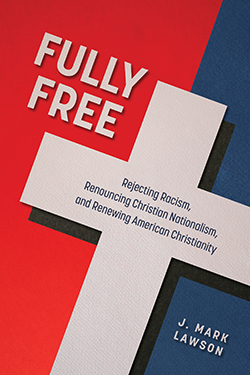
How did you come to write Fully Free: Rejecting Racism, Renouncing Christian Nationalism, and Renewing American Christianity?
While this book expresses ideas that I have been developing for many years, it was inspired by a particular experience in the summer of 2020. That’s when my wife Martha and I began attending a weekly outdoor prayer gathering organized by a group of Black pastors in Syracuse, New York. This was in the depths of the pandemic and right after the George Floyd murder, when lots of people became politically active for the first time. Martha and I had been to protest marches and rallies, but this prayer gathering was different. It was prompted by an alarming increase in the number of deaths by gun violence in Syracuse. Martha, a public-school teacher, knew students who had lost families members to gun violence, and she wanted to go to this gathering in concern for them. Each week for several months, we assembled in a circle at a different spot in the city where someone had been gunned down. In the manner of the Quakers, we began in silence and allowed people to offer a prayer, a hymn, or whatever words came to mind as they felt led. We gathered on busy streetcorners where people passing us either mocked us, slowed down to look at us, or even stopped and joined the circle. I became aware that we were experiencing “church” in a raw and amazingly authentic way. I was deeply moved and drawn into new friendships and long theological conversations with some of my Black colleagues in ministry. As we talked, I became newly sensitized to how deeply embedded racism is in our society, and to the ways Christian theology (bad theology that has nothing to do with Jesus, but Christian nonetheless) has been complicit in racial injustice.
A little more than a year after the prayer circle ended, I retired from local church ministry. I spent about six months in what I now see was a vocational sabbatical. And then, I decided it was time to write. What about? Freedom—the animating ideal of this country, the galvanizing hope of all historically oppressed people—particularly of African Americans—and an important theme in the arc of the biblical narrative. What if I traced the theme of freedom in the scriptures and in the process unmasked the theological heresies that have mitigated against freedom for so many but have been accepted as orthodox?
What is your hope for how your book might impact readers?
More than anything, I hope it sparks sacred conversations among Christian pastors and laypeople about who we are, what we believe, and what God is calling us to do in the United States of America during this time of great trouble. And of course, I hope we do more than talk. I hope the conversation leads to renewed interest in Bible study, new connections between majority-white and historically Black churches, and a clearer sense of mission. But it all starts with talking seriously and honestly with each other about issues that a lot of us have avoided for too long. Today, just about every expression of Christianity in America is in serious decline. We need more than updated strategies for outreach. We need a complete theological reformation that is based upon a fresh reading of scripture and is not afraid of painful truth. Because our religion bears so much responsibility for systemic racism in this country, we face a reckoning. Christian churches will either be major players in America’s redemption from its original sin, or we will recede into irrelevance. White Christian Nationalists, who are enjoying a resurgence today, believe the way to reverse the decline is to reassert by any means available the colonial version of our faith that gives privilege to some at the expense of the suffering of others. The rest of us know that Christian Nationalism, while it may wreak havoc in the short run, is not sustainable, and it is certainly not desirable. I hope this book will help readers discover how the gospel provides a healing, hopeful, and clear message in our time and place. We know what we are against. Too many of us are wringing our hands over everything that seems to be going wrong. But as disciples of Christ, what are we for? How do we understand and promote true, God-given freedom?
You reach across vast times, geographies, and histories in Fully Free, including your own. Can you talk a little about the structure? Why did you put it together in two parts and how did you decide which quotations and examples to use?
When I started, my goal was to trace the theme of freedom in the Bible in a book I imagined entitling Freeing Onesimus. But after a few weeks of writing, I realized I needed to do more. In the manner of a good sermon, I needed to apply the conclusions of my biblical study. At first, I thought of adding a chapter about the Black church as an example of the power of the biblical understanding of freedom. But then, I decided I needed to show how the Black church tradition has been largely hidden from the spiritual consciousness of most white American Christians, whose own theological approach to freedom has largely missed the mark and even abetted the persistent racism in American culture. This is an uncomfortable truth, but the dominant impulses in American Christianity are shaped by European theological developments that, on the one hand, racialized humanity, and on the other hand, undermined the church’s role of speaking truth to power in a prophetic way.
I wondered if I could fairly treat all these issues in a single work, so I graphed out a plan that would allow me to do the Scripture study and examine how biblical freedom speaks to the American ideal of freedom. That’s when I decided on a “Part 1” and a “Part 2.” Much of my material for Part 2 comes from teaching a college course on American Religion, as well as new research I did on West African spirituality and the historic Black church. (I am indebted to some African American pastors who pointed me toward a wealth of new scholarship that has burgeoned in the last few decades.) And the linchpin that would hold it all of this together would be Paul’s shortest epistle—the letter to Philemon—which gives us an intimate glimpse into an awkward, but sacred moment that tested everything Paul taught about “freedom in Christ.” Part 1 begins and ends with the relationship between Paul, the runaway slave Onesimus, and Philemon, Onesimus’ enslaver and Paul’s friend. I return to that story again at the end of the book.
I wrote the Introduction last, and in some ways that was the most rewarding part of this project. I grew up in a small Southern town that was very churched and also deeply and overtly racist. But my Southern Baptist pastor was a courageous leader who did not mind placing himself at risk by challenging the reigning orthodoxy. He befriended a Black Baptist pastor, and the two them engaged in a joint ministry that left an indelible mark on my Christian faith. Writing the introduction helped me to see how my own personal history with the Bible, church, and the specter of racism has led me to write this particular book in this particular time and place.
In Fully Free, you share about the juxtaposition of freedom and intolerance. What is this juxtaposition and what are the greatest misconceptions surrounding these ideas?
This is an American paradox. Settlers in the American colonies came seeking economic and religious freedom. But this promise of freedom was based on the notion of a “New World,” as though nothing had existed here before. So, from the beginning of our nation’s history, freedom has gone hand in hand with enslavement and cultural genocide. And that paradox is explained by a horrendous theological development that goes all the way back to the fourth century—a “supremacist” understanding of Christianity that first justified outright oppression of Jews, and later became the basis of racializing the human race, so that those with “lighter skin” (like Europeans, who had built an entire Christian society) more perfectly reflected the light of Christ, while people of darker skin tones could be relegated as “heathens,” “savages,” or simply bodies that could be exploited for free labor.
Obviously, none of this has any basis in the Scriptures, but a lot of creative theologians from the Middle Ages through the colonial era concocted ideas that became so commonplace in Christian preaching that we don’t even think to question them. We don’t consider how ideas like “Christianity as the only true religion” or Christ’s death as a “penal substitutionary atonement” are read into the Scriptures rather than drawn from them, and how they undergird a lot of societal injustice.
As a people of faith, what will be the most challenging part of achieving “freedom in Christ?”
The answer to that question will depend on one’s own experience. It will certainly be different for people raised in majority-white churches and for people who learned the faith in churches made up predominantly of non-white believers. True freedom in Christ is more than freedom from the letter of the Law of Moses, or freedom from guilt for personal sin. It is not license, but God-given responsibility to make the right choices and promote the values of God’s reign. We are most free when we are living as God wants us to live, unafraid of the consequences of doing so when we set ourselves against the prevailing values of the culture. None of us can realize this freedom all by ourselves. We need redemptive community with others who seek the same freedom. So, there are many challenges. We live in a world that is systemically destroying communities of all kinds, and we are inhibited by many layers of fear.
Speaking broadly about American Christianity, the greatest challenge will be forging a theological consensus that breaks though racial and ethnic barriers. Just as the Protestant Reformation began with a fresh reading of Scripture, so a reformation of American Christianity will require removing the theological lenses we’ve been trained to wear and studying the Bible anew. Ironically, this might be easier to accomplish in those circles of American Christianity that have suffered from decades of biblical illiteracy, since they won’t have to do as much deconstruction. But I firmly believe the basis of an authentic, liberating Christian faith is the grand narrative arc of the Bible—the whole story, that is—within which each part of Scripture must be interpreted.
What is the central lesson you can offer to those who feel discouraged, disconnected, or afraid about the state of American Christianity? Where is the power in a “reckoning”?
American Christianity is in such decline that we have nothing to lose and everything to gain. There’s great freedom in admitting that reality. And the people who feel the most discouraged are those who have personal experience with the redemptive power of church community. They carry the memory of something a growing number of people in our country have never known. One line from my book is that “the ecclesia [the original community called by Christ] formed me in spite of the church.” The essence of “church” has shaped people’s lives for good even though the institution of church has done a lot of damage. And Jesus promised that the ecclesia—not any of its institutional forms, but the essential church—would endure. Not even the power of hell would prevail against it.
What was the most meaningful or surprising experience you had in the process of writing Fully Free?
This is the kind of writing that I have long wanted to do, but really didn’t have time for when I was a full-time pastor. Writing has always been an important part of my ministry, but devoting the time necessary to integrate so much material in a cohesive way was a truly joyful experience.
How does your writing impact your faith? When did Scripture come alive for you?
Scripture has been alive for me since I learned Bible stories from Sunday School teachers who carefully pressed images onto flannel boards. I began to develop a passion for studying the Bible when I was an undergraduate college student. I was a history major, but I also spent a lot of time in the religion building, where faculty members opened up for me new ways of reading the text. I wrote a senior honors thesis entitled “The Historical Roots of Christian Anti-Semitism,” which was mostly a close study of New Testament texts within the context of first-century Judaism. I carried a lot of that study into my seminary work. Before I had earned my M.Div., I knew I needed more, so I entered the Ph.D. program and focused on New Testament theology. Equipped with a teaching degree, I faced a choice between being a full-time pastor and part-time professor, or full-time professor and part-time pastor. I chose the former. In all the time I was a pastor, I never stopped loving sermon preparation and teaching Scripture. So, while writing Fully Free was an impactful moment in my journey of faith, the more important truth is that my faith—and my life-long love of Scripture—could not help but impact my writing.
Login and Registration Form