
An Interview with Gregory Funderburk

Gregory Funderburk
Gregory Funderburk is a pastoral care minister, lawyer, and writer. He’s the author of The Mourning Wave, anovel about the Galveston storm of 1900 that was included among Kirkus Reviews’ Best of 2020: Our Favorite Indie Books and Best lndie Debut Novels of 2020.
Greg is also the author of two collections of essays published by Smyth & Helwys, Let It Be Said We’ve Borne It Well (2021), and Hurdles (2022).
He lives in Houston with his wife, Kelly. They have two sons, Hank and Charlie.
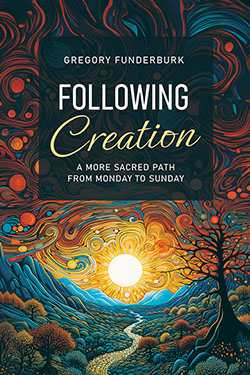
How did you come to write your new book, Following Creation: A More Sacred Path from Monday to Sunday?
I write an essay every week for the church I serve as a pastoral care minister. I’ve been doing this for about four years and around the end of every year, I step back and read over the essays to see if a unifying theme has emerged. One of the essays I wrote in 2023 introduced the idea of using the work God accomplished each day in the Creation narrative from the book of Genesis as a model for our lives. That is, to consider the nature of God’s labor in those first seven days of Creation and reflect that out into the world. And while clearly we can’t speak light into being or pull the land from the sea—in a metaphorical sense, we kind of can. We can bring light and hope into the world with our words on Mondays, and we can pull some sense of order from the chaos all around us on Tuesdays. Every day of the Creation narrative, God did something elemental and marvelous, and every day, on a human scale, we can too.
What is your hope for how your new book might impact readers?
There are so many demands on each one of us that it’s easy to feel overwhelmed, even dispirited, in the bustle of life. I think almost all my writing is designed to push back against this. More than just trying to be optimistic though, I think those of us with a temperament that naturally leans toward hope, have an obligation to point people toward it, making it credible and accessible. This book, in a series of short, story-shaped doses, aims to offer light, order, grace, and encouragement in a way that gently reminds us to be grateful for the windfall of life.
What does the Creation story mean to you and why did you choose it for the base structure of Following Creation?
I just find it remarkable how these ancient writers and thinkers imaginatively, poetically, and I believe prayerfully, crafted this iconic story to explain to themselves and their progeny how everything came into being. I believe it was truly inspired by God because it’s helped human beings survive and thrive since its emergence. It’s still around and we still read it because it still helps us to make sense of things. It helps us to keep asking the right questions. The big questions. It’s survived for thousands of years because it’s so compelling and revealing not just on the subject of what we think about God, but how we see ourselves. I chose it for these very reasons—there’s such wisdom embedded inside of it.
What was the most challenging aspect of this project in comparison to your other books, Hurdles and Let It Be Said?
The essays that comprise my previous books, Hurdles and Let It Be Said, are grouped together in a thoughtful way, but the essays are probably a little bit more stand-alone in some sense. I think Following Creation has more continuity page to page. It hangs together maybe on a stronger scaffolding, a higher concept. Organizing and editing it therefore took some extra work, crafting the language, to keep the premise front and center throughout the sections.
In your introduction you mention that this book is for those looking for a “more sustainable rhythm for communion with the divine.” As a people of faith, why is this sentiment important and how can it be misunderstood?
There’s a great clip on the internet in which the late author, David Foster Wallace, offers a commencement speech to the graduates of Kenyon College in 2005. One of the things he tells them is this: “Everybody worships. The only choice we get is what to worship, and the compelling reason for maybe choosing some sort of god or spiritual-type thing to worship—is that pretty much anything else will eat you alive…On one level, we all know this stuff already— it’s been codified as myths, proverbs, cliches, epigrams, parables; the skeleton of every great story. The whole trick is keeping the truth up front in (our) daily consciousness.”
He’s saying we all worship something or someone. And as believers, we’ve quite rightly in my opinion, chosen to worship God, but we need to keep this, as Wallace puts it, up front in our daily consciousness. We want to be devoted to God, but our minds tend to wander. Most of us need routines, some habit-forming devices that remind us not only that we have the incredible opportunity to commune with God each day, but also remind us also of what God wants us to be doing with our days. I don’t want it to be misunderstood as just a rigid formula to advance one’s discipleship, but I hope this book will provide a pattern to follow until it becomes a practice—a habit of becoming more attentive and thoughtful about how we spend our days with God and then out in the world, as well.
Can you talk a little about Following Creation’s structure? How are readers suggested to approach each chapter/section and how did you decide on the sub-themes within each day of the week?
After developing the concept of using God’s work from the Creation narrative as a model for our own lives, it was then a matter of thinking through what God did on each day and translating it down to human size, scaling it down to the things that we, as human beings can do. So, I began to ask questions along these lines: What would it look like to offer light into the world on the first day of our own work week; What would it mean to try to bring order out of chaos on the second day of each week; Just as God did in creating the grass and the plants on the third day, how might we focus on growth on the third day of the week; On the fourth day, could we make more time for experiencing a sense of awe in our lives as God did in creating the sun, moon, and stars; Could we then, on the fifth day, be more intentional about using our imagination as God seemed to do when God created all the animals of the world; and finally on the sixth day, just as God solved the loneliness problem for us, what might building up community and banishing loneliness look like if we took up such a project each Saturday.
A reader might just work his or her way through the book from front to back, but the way it might be most effective to read it would be to read a Monday essay on Monday, then a Tuesday essay on Tuesday, et cetera. There are ten readings for each day of the week, so it would take about a year to do this, which would well-seed a habit and establish a pattern for one’s life.
What advice do you have for those struggling with certain days of the week’s activities? For example, how to find one’s own courage to offer authentic encouragement as described on Monday?
Well, we all have different temperaments. Some of us are attuned toward hope and optimism. Some of us are better at organizing, of drawing order from chaos. Others have a real capacity for leaning into awe and using their imaginations. Still others are terrific at relational connection. None of us are stellar at all of it, so I would suggest trying to become more self-aware of how God has gifted you and celebrate and do that in a primary and intentional way, then work on those things that don’t come quite as easily over time. But I think it’s interesting to consider the broad range and character of all that God did in this first chapter of Genesis, and to make it all both a part of our worship—marveling at all that God is and does—and a part of our discipleship by asking in what areas might we need to work further to become more complete human beings and more Christ-aligned disciples.
On a more personal note, when did Scripture first come alive for you?
Louie Giglio worked for a summer at the church I grew up in, then when I was at Baylor, he was starting up the weekly Bible study that grew into the Passion movement. Louie has a unique way of mining Scripture, illuminating overlooked details in such a compelling way that I not only began to study Scripture more closely, but began to see the genius of it in a new way, both in the brilliance of its story-telling and in the practical wisdom it offers. Louie had and still has a singular way of dropping you into a Biblical story or text which makes you feel like you’re walking around alive in it. Every week at Baylor, I’d leave thinking, “I’d heard that passage before, but had never thought of it like that at all.” Louie also seemed to refer to a particular translation of the Bible in his teaching a good bit—Kenneth S. Wuest’s Expanded Greek Translation of the New Testament. I picked up a copy somewhere along the way and still use it, as its language always seems to offer fresh insight into familiar passages. I referred to it in one of the chapters in Following Creation called “A New Kind of New.”
Login and Registration Form