
An Interview with Eric Howell

Eric Howell
Eric Howell, D.Min. is Pastor of DaySpring Baptist Church in Waco, TX. He also teaches Creation Care as Spiritual Practice at George W. Truett Theological Seminary at Baylor University.
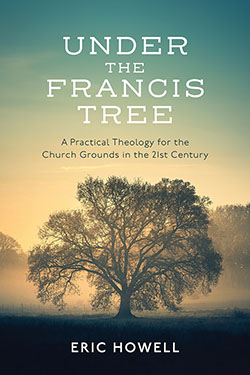
How did you come to write Under the Francis Tree: A Practical Theology for the Church Grounds in the 21st Century? What do you hope laypeople can take away from this book?
I loved writing this book and praying for conversations and conversions I hope it will spark. I wanted to share some stories of our congregation’s experience with gardens, compost bins, and labyrinths. I also wanted to go beneath the topsoil, deep down in the sticky, hard clay of our cultural, economic, religious, and spiritual dislocations. I believe that our relationship with the environment is coupled with challenges that down deep are interwoven. My hope is that pastors, lay people, and anyone interested in sacred ground can find pathways to reflection and engagement with the places they love.
What are some misconceptions surrounding ecological interpretation and the church?
The number one misconception is that care for creation is only a liberal concern. This idea, fueled strategically by industrial and economic interests, overlooks one of the major themes of the scripture. Israel is always called to relationship with God, with one another, and with the land. And Christianity begins in the Incarnation—the Word made flesh—baptism in water, and bread and wine. Care for creation, and delight in creation, is a biblical concern from Genesis 1 until the end of Revelation. The ecological crises of our day are calling Christians to recover and renew our witness to Christ through redemptive participation as in a creation brought into being life to receive Christ. This is the issue of our century for the planet and unmistakable opportunity for the Church’s witness in the world.
How are both church and non-church grounds able to have multi-functional presences? As a people of faith, how can we be more open and active within these different functions?
Land can have many uses ranging from contemplative to recreational to productive and a church’s grounds may have varied opportunities along this spectrum. Our place in Waco for example has walking trails and a community compost bin, room for parking and a playground . . .various uses. In all of these possibilities, Alan Jones points our discernment in the right direction, “We either contemplate or we exploit. We either see things and persons with reverence and awe, and therefore treat them as genuinely other than ourselves; or we appropriate them, and manipulate them for our own purposes.” Franciscan spirituality holds a place for both contemplative and active uses as sacred if we approach with a non-exploitive spirit.
What was the most meaningful or surprising experience you had in the process of writing Under the Francis Tree?
In researching the book, I had to confront some serious challenges—climate change, racism, the relentless cycle of desire-consumption-waste in modern life, dualism—so, as you can imagine, there were some nights that were despairing. I think that’s unavoidable if we are to be honest about modern life. And yet, I find myself encouraged that the Christian witness to Christ is the world’s best hope through this trouble—in Christ there’s a spirituality to our environmental efforts and there’s an environmental implication in our spirituality. This is the ecology of grace.
I wanted to ask you a little bit about the structure of your book. You mention that you were inspired by Richard Osmer’s tasks. What are Osmer’s tasks and why did you choose to reframe them as “forms of prayer: gaze, consider, contemplate, imitate” for your structure?
I wanted to demonstrate how a care for creation is not just an elective add-on for eco-alert individuals, but is profoundly theological, deeply prayerful, and fully scriptural vocation for the Church. Richard Osmer is a pastor’s theologian whose methodology follows tasks each correlated with an office of Christ: Priestly Listening, Sagely Wisdom, Prophetic Discernment, Servant Leadership. By the time I came to Osmer, I’d been following St. Clare’s prayer for a while, so it didn’t take me long to recognize the Christological correlation between this modern theologian and the medieval mystic’s holistic approach to prayer. And when I saw the same pattern evident in Moses at the Burning Bush, I knew we had something important here! I hope readers will experience the book in multiple layers as an exercise in practical theology (with Osmer), a path to prayer (with St. Clare), and a biblical exegesis (with Moses).
What is your advice to those who are overwhelmed, but still want to actively participate in cultivating care?
Start small. Do well. Start now. I heard that wisdom recently from Ugandan Bishop Emmanuel Katongole talking about the Bethany Land Institute. Life is a pilgrimage in which we need a place, a community, and a belief that ultimately everything matters in God’s economy of grace. The spiritual principle of ecology is that everything is in community and relationship with all else, which means that anywhere, anytime, any way you reconcile, heal, welcome, nurture—whether people or place—you are taking steps—even baby steps—against despair. Practically said, the easiest rung on the ladder to grasp is composting your kitchen waste. Start there and see where the path takes you.
How to do the requirements and challenges of preaching inform your writing?
My aim in preaching to offer sermons which I hope are simple enough for a person new to faith or a child to understand while also deep enough to speak to the mystic and theologian. I hope the book will as well. I had this in mind when including stories such as the story of travelling with my family to Glacier National Park alongside the fairly lengthy engagement with Maximus the Confessor. Both are really important to me and I hope, will be to the reader.
What is it about the wilderness/nature that nurtures your imagination?
Our backyard outside Waco ends on the banks of the Middle Bosque, a small river, inconsequential to most people, but even this little river tells a story. That’s what is inspiring me recently. This river’s canyon has been a refuge for those fortunate to live along its banks—and there aren’t many. Richard Phelan, the Texas naturalist and author who loved this area, wrote lyrically about it. For President George W. Bush, his Crawford Ranch on the river was a retreat during his presidency. And perhaps—my theory—escaping slaves who we know used river beds like this one to flee Central Texas enslavement to go west and then south to Mexico and freedom. There is drama and life all around us if we have eyes to see.
Login and Registration Form