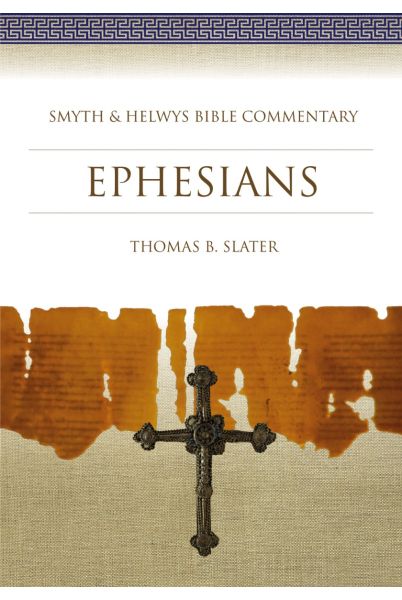
Thomas B. Slater’s commentary on Ephesians transports the modern reader into the world of the early church. Slater asserts that Ephesians was written to persuade its original readership that an ethnically inclusive church based on religious affiliation and faithfulness was part of God’s plan and that both Jew and Gentile were equal partners in the new religious commonwealth. Slater addresses important questions:
• What does it mean to live in a racially inclusive community?
• What are Paul’s ethical requirements for living in such a diverse setting?
Following Christ’s model, Ephesians espouses virtues and relationships that could ensure harmony and peace within the Christian church. The commentary argues that Ephesians is deutero-Pauline but faithfully reinterprets the Apostle for a new generation of first-century Christians.
Thomas B. Slater was professor of New Testament Language & Literature in Mercer University’s James & Carolyn McAfee School of Theology. Slater has published in leading scholarly journals around the globe, including Journal of Biblical Literature, New Testament Studies, and Biblica. Before coming to Mercer, he held a dual appointment at the University of Georgia in the Institute of African American Studies and the Department of Religion. A recipient of both an Overseas Research Scheme Award to pursue doctoral studies in the United Kingdom and a research grant from the Society of Biblical Literature to work on the Son of Man question, Slater has degrees from Perkins School of Theology, SMU (MTh, DMin) and King’s College London, the University of London (PhD). Slater is also an elder in full connection in the Georgia North Region of the Christian Methodist Episcopal Church.
Thomas B. Slater’s commentary on Ephesians transports the modern reader into the world of the early church. Slater asserts that Ephesians was written to persuade its original readership that an ethnically inclusive church based on religious affiliation and faithfulness was part of God’s plan and that both Jew and Gentile were equal partners in the new religious commonwealth. Slater addresses important questions:
• What does it mean to live in a racially inclusive community?
• What are Paul’s ethical requirements for living in such a diverse setting?
Following Christ’s model, Ephesians espouses virtues and relationships that could ensure harmony and peace within the Christian church. The commentary argues that Ephesians is deutero-Pauline but faithfully reinterprets the Apostle for a new generation of first-century Christians.
Thomas B. Slater was professor of New Testament Language & Literature in Mercer University’s James & Carolyn McAfee School of Theology. Slater has published in leading scholarly journals around the globe, including Journal of Biblical Literature, New Testament Studies, and Biblica. Before coming to Mercer, he held a dual appointment at the University of Georgia in the Institute of African American Studies and the Department of Religion. A recipient of both an Overseas Research Scheme Award to pursue doctoral studies in the United Kingdom and a research grant from the Society of Biblical Literature to work on the Son of Man question, Slater has degrees from Perkins School of Theology, SMU (MTh, DMin) and King’s College London, the University of London (PhD). Slater is also an elder in full connection in the Georgia North Region of the Christian Methodist Episcopal Church.

Login and Registration Form