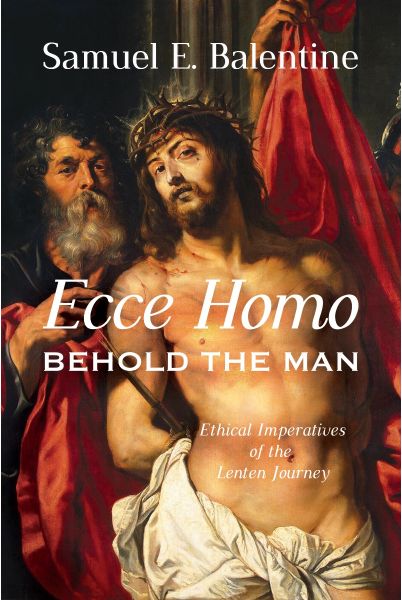
The Lenten journey is mapped by an imperative, twice spoken, from different perspectives. The first perspective is that of Pilate, who presents Jesus—bound, scourged, crowned with thorns, and wearing a purple robe—with the words, “Behold the man” (John 19:5). The second is that of the resurrected Christ who says to the disciples, “Look at my hands and feet . . . . Touch me and see” (Luke 24:39). Pilate offers the perspective of the onlooker, one whose power and privilege make it possible to endorse the abuse of another person and to look on their suffering from a safe distance. Christ’s words, on the other hand, convey the experience of one whose first-hand experience with suffering makes it impossible to ignore the reality of brokenness and loss.
The Lenten journey requires that we understand what it means to view suffering from both perspectives. What are we supposed to see when we behold this innocent man, beaten and condemned? What are we supposed to feel when Jesus shows us his wounds and says, “Look at my hands and feet . . . . Touch me and see”? More importantly, what are we supposed to do in response to the ethical imperatives of the Lenten journey? How we answer these questions will define both the journey we are making toward the empty tomb and the affirmations we will speak as our own on Easter morn.
Samuel E. Balentine is Professor of Old Testament and Director of Graduate Studies at Union Presbyterian Seminary in Richmond, Virginia. He is the author of numerous books, including Job, a volume in the Smyth & Helwys Bible Commentary series, for which he serves as Old Testament General Editor. He is Series Editor of Interpretation: Resources for the Use of Scripture in the Church, Editor-in-Chief of The Oxford Encyclopedia of the Bible and Theology, and Editor-in-Chief of The Oxford Handbook of Ritual and Theology in the Hebrew Bible.
Ecce Homo, written by an accomplished biblical scholar well-versed in art historical method, offers insightful reflections on scriptural narratives and corresponding works of art. Samuel Balentine places each story in its original historical context while providing a relatable meaning for the contemporary reader. The art, selected from across the centuries, further allows the reader to “see” the biblical verse as Balentine guides us with his words along a journey originally presented as a Lenten preparation.
—Heidi J. Hornik Professor of Art History Baylor University
Balentine takes on a subject that causes discomfort or pain to every Christian, but no one talks about directly: How do we look upon the pain of others in a way that is a genuine and compassionate witness to our own faith? Beautifully yet simply written, keenly sensitive to Scripture, art, and instances of suffering in our own world and the lives around us, this is a book to be shared widely in the church and even beyond it.
—Ellen F. Davis Professor of Bible and Practical Theology Duke University
The Lenten journey is mapped by an imperative, twice spoken, from different perspectives. The first perspective is that of Pilate, who presents Jesus—bound, scourged, crowned with thorns, and wearing a purple robe—with the words, “Behold the man” (John 19:5). The second is that of the resurrected Christ who says to the disciples, “Look at my hands and feet . . . . Touch me and see” (Luke 24:39). Pilate offers the perspective of the onlooker, one whose power and privilege make it possible to endorse the abuse of another person and to look on their suffering from a safe distance. Christ’s words, on the other hand, convey the experience of one whose first-hand experience with suffering makes it impossible to ignore the reality of brokenness and loss.
The Lenten journey requires that we understand what it means to view suffering from both perspectives. What are we supposed to see when we behold this innocent man, beaten and condemned? What are we supposed to feel when Jesus shows us his wounds and says, “Look at my hands and feet . . . . Touch me and see”? More importantly, what are we supposed to do in response to the ethical imperatives of the Lenten journey? How we answer these questions will define both the journey we are making toward the empty tomb and the affirmations we will speak as our own on Easter morn.
Samuel E. Balentine is Professor of Old Testament and Director of Graduate Studies at Union Presbyterian Seminary in Richmond, Virginia. He is the author of numerous books, including Job, a volume in the Smyth & Helwys Bible Commentary series, for which he serves as Old Testament General Editor. He is Series Editor of Interpretation: Resources for the Use of Scripture in the Church, Editor-in-Chief of The Oxford Encyclopedia of the Bible and Theology, and Editor-in-Chief of The Oxford Handbook of Ritual and Theology in the Hebrew Bible.
Ecce Homo, written by an accomplished biblical scholar well-versed in art historical method, offers insightful reflections on scriptural narratives and corresponding works of art. Samuel Balentine places each story in its original historical context while providing a relatable meaning for the contemporary reader. The art, selected from across the centuries, further allows the reader to “see” the biblical verse as Balentine guides us with his words along a journey originally presented as a Lenten preparation.
—Heidi J. Hornik Professor of Art History Baylor University
Balentine takes on a subject that causes discomfort or pain to every Christian, but no one talks about directly: How do we look upon the pain of others in a way that is a genuine and compassionate witness to our own faith? Beautifully yet simply written, keenly sensitive to Scripture, art, and instances of suffering in our own world and the lives around us, this is a book to be shared widely in the church and even beyond it.
—Ellen F. Davis Professor of Bible and Practical Theology Duke University

Login and Registration Form