
An Interview with Christopher O'Rear
Christopher O'Rear
Christoper D. O’Rear is an ordained minister and licensed clinical pastoral therapist in Tennessee and the owner of The Counseling Center, PLLC, in Nashville. He has master’s degrees in divinity in pastoral care and counseling and in marriage and family therapy. Before becoming a licensed psychotherapist, Chris worked as a hospital chaplain.
In addition to his work as a therapist, he is also a teacher, lecturer, and supply preacher and regularly writes lessons for NextSunday Resources's Formations curriculum.
Chris lives in Nashville with his wife, Lynda, and they have two grown daughters and two wonderful sons-in-law. Chris is an animal lover and enjoys motorcycle riding.
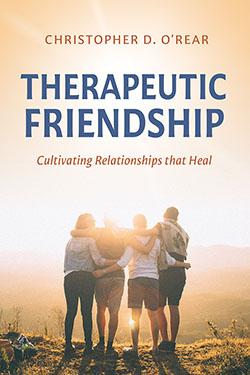
How did you come to write Therapeutic Friendship: Cultivating Relationships that Heal? What do you hope others will gain from reading it?
About thirty years ago, I had a profound encounter with a friend at a time in my life when I felt unloved and unlovable. That experience, outlined in the introduction to the book, was a huge turning point in my life and I began to try figure out how I could be a friend like that to others – both personally and professionally. In my professional practice of psychotherapy, I also began to realize that many people do not have deep and meaningful relationships with others because they have not learned or experienced the things necessary to make better connections. Subsequently, so many people feel overwhelmingly lonely despite being surrounded by people daily or connected to so many via the internet. I wanted to share things that I have learned through training as a therapist, my years of being a therapist, and my own personal journey that I thought would help people form more meaningful connections with themselves and with others. Ultimately, I see this connection with self and others as spiritual experience that connects us with the divine. My hope is that people will learn something of themselves in this book and learn how to better connect with others so that their relationships feel more meaningful. I hope that people will find this book one piece of a larger antidote for the epidemic of loneliness that so many people are experiencing.
One of my secondary motives for writing the book was to help demystify the process of psychotherapy and because of that, I have included some counseling theory and a “peek behind the curtain” of psychotherapy process. I have been surprised by the number of psychotherapists and pastoral care givers who have suggested that this book would be a good resource for people who are early in their training in these fields. I am excited about the possibility of “Therapeutic Friendship” being used in this way.
What is the biggest misconception about psychotherapy, in general, and, in a context of faith?
Both in a context of faith and outside of that, too many people think of therapy as something that is only needed by weak people or people who have failed in one way or another. Too many people come to my office feeling shame because they think being there reflects some form of failure or weakness on their part. Many people of faith believe that reading their bible more or praying more should give them all that they need to live deeply meaningful lives with healthy relationships. The reality is that no one is born with an innate knowledge of what makes for emotional health and healthy communication. People work really hard with what they know or what they think will be helpful, but they may not have all of the insight and tools necessary to be successful. While a therapist can help a person discover things about themselves and there are some basic skills that can be learned, no two people have exactly the same story and no treatment is a one-size-fits-all. So, unlike other professionals that we might consult about challenges we have, a good therapist is not an expert with all of the answers, but more of a guide to help a person discover the unique things about the strengths and challenges in their own experience and how to grow in ways that will be meaningful for them.
Can you talk about the structure of your book? How did you decide to organize the chapters?
Because I conceptualized this book as a kind of guide for making better relationships, I wanted to cover a variety of aspects of healthy relationships. Several chapters include basic concepts of healthy connection and deeper connection. I also felt it was important to look at some of the common challenges or defense mechanisms that people utilize (consciously or unconsciously) to avoid difficult emotions or relational vulnerability. The reality is that any relationship of significance will have times of possible conflict. So, I thought it was important to offer some practical advice about how to understand and navigate conflict when it occurs in order to find resolution that deepens connection rather than causing deeper hurt or breaks in the relationship. One of the challenges many people experience is how to be present with a friend when they are going through something difficult. Many people have avoided being present or have said and done things that are actually hurtful in an attempt to be helpful. I thought it important to give some guidance on what is meaningful, what is helpful, and what is not when attempting to be supportive of someone in a crisis. Finally, not all relationships are going to last forever. I wanted to acknowledge this reality and reflect on when and how some relationships end and distinguish between a good ending and one that is not as healthy. I hope the book covers a broad scope of the ebb and flow of relationships and contains examples and concepts that can be adapted to novel situations.
What advice do you have to those, as a people of faith, who want to break down atmospheres of silence and encourage openness rather than hiding?
Our communities of faith are too often places where we feel like we have to have a positive outlook, provide the expected “Christian” answers for life’s challenges, and avoid admitting that we struggle with aspects of life and faith. Too often we fear that others do not struggle as we do and fear that if we share the truth of our lived reality, people will see us as weak or as a failure in our faith. I think it is important that we normalize the challenges of life and faith. Church leaders need to normalize struggles and challenges from the pulpit. We need leaders who are willing to be vulnerable and honest about their own experiences. Churches can work to create small group communities that nurture connection and emotional safety. We need educational opportunities to help people know how to better encourage and support one another in difficulty. Vulnerability by one person often invites vulnerability in others. Being open and vulnerable does not mean that we walk around indiscriminately sharing everything about ourselves, but I think we could generally do a better job of creating spaces where deeper, more personal, sharing might occur. On a smaller scale, people who desire such connection can seek out others for more private conversations over coffee or a meal and test the waters of vulnerable connection and sharing. In the book, I describe how this can sometimes feel like dating, as we seek out people with whom we can connect with beyond the social pleasantries of our usual existence. However, finding a person like this (or two) in our lives can be very rewarding and meaningful.
What is “humble curiosity” and how can it encourage meaningful emotional relationships in our lives?
Humble curiosity is an open and receptive stance towards another person that is critical for therapists to learn in their training in order to better connect with their clients and I think it is a concept that has a larger application. When speaking with another person, it is important to suspend our own ideas of what we think is happening, what should be happening or what another person means and approach them with curiosity. Too often in conversations, we listen to others while formulating our own responses because we already think we know what another person means or what they think. To listen in order to understand is a different approach. If someone has an experience different than your own, you can ask them to tell you more about it. You can reflect back to them what you hear them saying to verify that you have understood what they have said. It is also important to remember that just because someone uses a word or concept that you know, you cannot assume that you know exactly what they mean. If someone says, “I feel depressed” or someone says, “I have been praying about that”, in an appropriate setting we might ask, “What does depressed feel like to you?” or “Tell me how you pray”. These types of questions invite a deeper sharing than we are accustomed to in our regular lives, and they help us better understand another person’s experience. Even if we feel strongly about our beliefs or ways of doing things, we can still set that aside momentarily to ask another person about their experience or way of doing things—humble curiosity. I have been amazed in my own experience of being a therapist, client, and friend, how powerful it is when a person feels understood by another person. Just having someone reflect back to us what we just said can feel so caring. This is why I felt it important to give some time to this in the book.
You included a story about your friendship with Kyle in your book that seems to have been important for you. How did that friendship help with your understanding of this concept?
I love telling the story of my relationship with Kyle Cantrell and I give more detail to our friendship in the book. However, Kyle and I had very different views and beliefs and I could not have imagined a significant relationship with him before I got to know him. What I learned from our time together was that we should not make assumptions about those with whom we disagree. We should not see them as enemies. Kyle and I acknowledged that we did not share the same beliefs about things, but with “humble curiosity” we could better understand one another and we learned that we had so much in common beyond the things that we imagine divided us.
How does writing impact your life? What part of writing Therapeutic Friendship was most surprising and most challenging?
I am not great at making time in my life to read or write. Both are challenges for me. However, I find writing to be rewarding when I make myself do it. I am much better when I am writing something like Sunday school lessons because there is a deadline that forces me to prioritize the task. When I am writing, I enjoy the process of study, reflection, connection of ideas and the process of bringing some structure to what can feel like a chaotic collection of concepts. The concept for the “Therapeutic Friendship” had been in my head for years and I continued to think about various concepts that I could include. I had made some attempts to write the book but had made only minimal progress. I finally decided that if I were ever going to get it done, I needed to have a deadline. I was blessed that Smyth & Helwys was interested in the book, and we agreed on a timeline to finish it. That deadline kept the writing in the forefront of my schedule where other things can too often creep in and push writing to the bottom of my to-do list. I have a couple of other ideas for books that I hope I will get written, but in the meantime, preaching and writing shorter projects are meaningful outlets for me.
When did scripture come alive to you?
That is a very interesting question. I have always considered the Bible important for encouragement and guidance. As a younger person, my reading of the Bible was more literal than it is now, and I drew from it a more moralistic interpretation that focused more on right living. However, because I was focused more on following the rules, I became more aware of who was following and who was not. I became more judgmental than loving and my understanding of the Christian life was narrower than it is now.
That event in my thirties almost immediately affected the way that I understood God’s love. That, in combination with my previous learning in seminary began to broaden my understanding. As I continued in my own therapy and learning in psychology theory, I learned more about what makes for healthy self-esteem and healthy relationships. When I read scripture through those lenses, I began to see that health, wholeness, love, and compassion were very much a part of the story of the Bible. What I brought to the words affected what I read in the words. I have continued to be a student of scripture. I believe that the Bible is inspired, and I believe it is a product of humans who lived in a particular historical context. In that context, I see the struggle of people who are very human and the power of the love of God that transforms as it is lived out in the lives of those who are the children of God. I find something new each time I spend time in study, and I continue to be inspired to live in the way of Jesus.
Login and Registration Form